
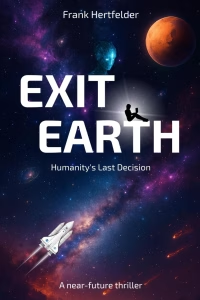
Exit Earth: Humanity’s Last Decision
When the world trembles on the edge of disaster, stories that blend survival, ethics, and raw human emotion hit hardest. Frank Hertfelder’s novel Exit Earth: Humanity’s Last Decision doesn’t just paint a bleak vision of the future, it forces readers to imagine their own choices when faced with humanity’s end.
This near-future thriller drops you into a world collapsing under natural disasters, political conflict, and resource wars. The story begins with an ultimate decision: Earth can no longer sustain life, and 10,000 people are chosen for evacuation to Mars. That’s humanity’s final chance to survive, and the selection process is where both suspense and heartbreak collide.
A Story That Tests Morality
At the center of this tale is Leona Miles, an ethics professor suddenly thrown into the most personal dilemma imaginable. She’s faced with a possibility to save her daughter, Sam, but only if she accepts the cold, calculated system deciding who makes it onto the ships.
The twist comes in the form of MERCY, an advanced artificial intelligence tasked with making the final selection. MERCY represents efficiency and order, but Leona sees something darker in its choices. Should humanity’s survival really be decided by a machine? Can compassion survive when survival itself is rationed?
These questions aren’t abstract in the story. They’re woven into every tense moment, making readers stop and think about their own lines in the sand. Would you trust the system for the greater good? Or would you risk it all for the ones you love?
A Thrilling Vision of the Future
What makes Exit Earth stand out isn’t just its plot, but the way it mirrors real fears of our own time. Climate crisis, AI ethics, and political unrest are already shaping today’s headlines. Hertfelder’s narrative pushes those anxieties forward to 2055, where Cairo becomes the backdrop for the world’s desperate attempt at survival.
The pacing is sharp. Reviewers describe it as unputdownable, and it’s easy to see why. Each chapter ramps up the urgency. The world feels both familiar and unsettling, with the stakes raised to the extreme: survival versus humanity’s very identity. The mix of science fiction, moral conflict, and emotional drama ensures the book speaks to fans of dystopian thrillers as much as those who love character-driven stories.
One reviewer summed it up perfectly: “This story shook me. Leona’s impossible choice made me question what I’d do to save someone I love.” That emotional punch is the thread running through the entire book.
About the Author: Frank Hertfelder
Frank Hertfelder isn’t only a novelist. He’s an entrepreneur, financial expert, and certified planner with more than forty years of experience guiding people and businesses through change. His professional background gives him a unique lens to explore topics like artificial intelligence, shifting markets, and the ethics of technological control.
Yet writing has been part of his life since he was a teenager. At sixteen, he published his first short story, Night Falls on Calcutta. That creative spark never left. Today, he writes socially critical novels, children’s stories, and thought-provoking works that mix empathy with insight.
Hertfelder’s ability to cross between the world of numbers and the world of narrative gives his writing a rare depth. He blends hard analysis of technology’s impact with storytelling that reaches the heart. His coaching and mentoring experience with young people also shapes his approach, making his books resonate on both intellectual and emotional levels.
Why Readers Are Captivated
The reviews speak volumes. Readers call it gripping, atmospheric, and deeply unsettling in the best way. Many compare the experience to watching a powerful science fiction film, with tension that doesn’t let up until the very end.
What sets Exit Earth apart is how it makes survival more than a game of numbers. It asks what we sacrifice when we hand decisions about humanity to machines. It challenges the reader to think about what really matters when everything is at stake.
Hertfelder’s work feels both thrilling and prophetic. It’s a story that lingers, sparking reflection long after the last page. In a time when AI, climate concerns, and global instability are very real, this book lands with even greater impact.
Get your story featured on Betterauds.com! You can submit your article here