
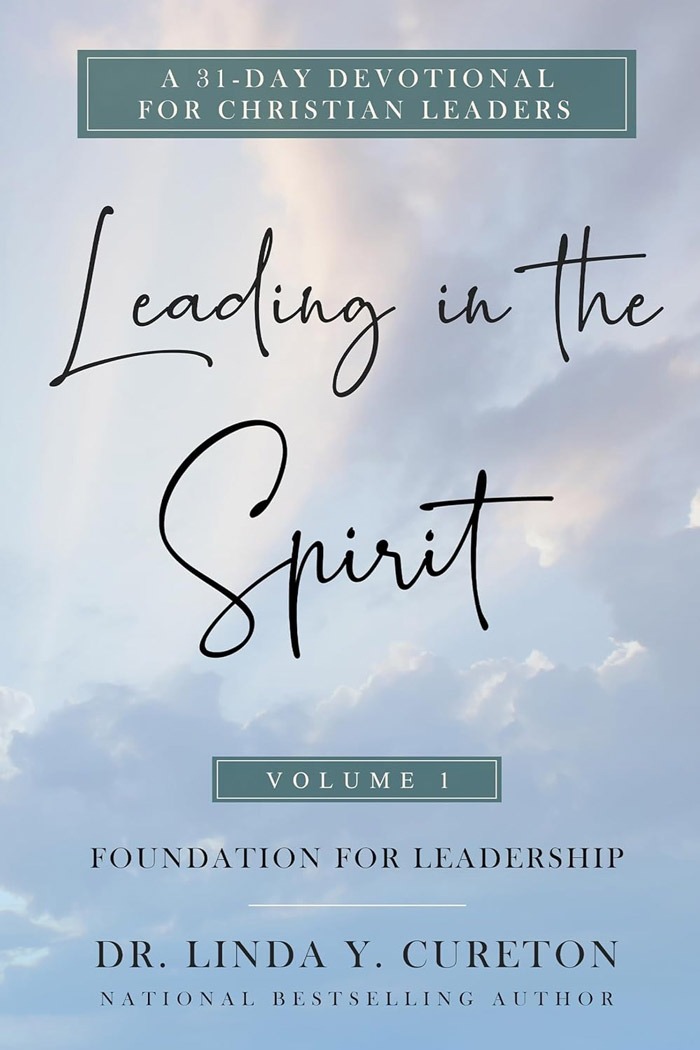
Leadership can feel like carrying a bright torch in a gusty wind. People expect direction, confidence, and calm, even when the leader is sorting through questions in private. In Leading in the Spirit: Foundation for Leadership, Dr. Linda Cureton speaks to that reality with a steady, welcoming voice. She writes for leaders who have heard the call to lead and have also felt how heavy that call can become during meetings, decisions, and quiet moments of doubt.
The book is a 31-day devotional created for leaders who want their leadership rooted in the Spirit of God. Instead of pushing productivity tips, Linda guides readers toward divine alignment, where identity and purpose come from God’s presence rather than from a role, a title, or a scorecard. Each day invites a leader to slow down, listen, and lead with authenticity and grace.
A Daily Rhythm That Fits Real Life
The format is approachable: one reading per day for 31 days. Each entry blends Scripture with reflection and practical insight, then makes space for the reader to respond. That rhythm is a gift for busy leaders who move quickly from one responsibility to the next. A short pause can reshape the whole day, especially when the leader is under pressure to deliver results and care for people at the same time.
As readers move through the devotional, they see leadership reframed as stewardship. The emphasis stays on trust. A leader is entrusted with influence, relationships, timing, and decisions that affect others. Linda treats that trust as sacred, and she helps readers notice where personal ambition can crowd out spiritual listening. The pages consistently point back to God’s voice, reminding leaders that discernment grows through attentiveness.
Discernment in Uncertainty and Strength for the Long Road
Many leaders know the feeling of uncertainty, when the next step is unclear and answers seem delayed. Linda addresses those seasons directly. She encourages readers to discern God’s voice without panic and to practice patience when clarity arrives slowly. This approach can comfort leaders who feel responsible for outcomes and want to respond with wisdom.
One of the book’s strongest themes is the wilderness. Linda presents the wilderness as preparation, a place where character deepens and calling matures. Alongside that, the devotional highlights spiritual disciplines that build integrity, courage, and clarity. Prayer, reflection, and quiet obedience become leadership practices.
Rest also receives careful attention. Linda invites leaders to rest in God’s timing, which can reduce the impulse to control. Rest is shown as active trust, something that strengthens decision-making and steadies the heart. Over time, the daily readings encourage a shift from strain to peace, from pressure to balance, and from self-reliance to communion with the Spirit.

The Leader Behind the Pages
Dr. Linda Cureton’s career adds real-world texture to the devotional’s spiritual focus. With more than 30 years in Information Technology, she has served in demanding environments where decisions carry wide consequences. She is described as a former Chief Information Officer of the National Aeronautics and Space Administration (NASA), where she advised the NASA Administrator and provided technology leadership alongside scientists and engineers. She also held executive roles including Associate CIO at the Department of Energy and Deputy CIO at the Bureau of Alcohol, Tobacco, and Firearms.
Her work has earned recognition including the 50 Women of Influence and Power Award from the Minority Enterprise Executive Council, the Womensphere Global Leadership Award for Innovation, and the ITSMF Summit Heritage Award. She has also been recognized by the Washington Business Journal as one of the Women Who Mean Business, by Washingtonian Magazine as a Tech Titan 2011, and by Federal Computer Week as a Fed 100. She writes and speaks often, with a focus on leadership, mentoring, and technology.
Who Will Enjoy This 31-Day Journey
This book serves leaders who want spiritual clarity while staying fully present in daily work. It speaks to executives, managers, founders, ministry leaders, and anyone carrying responsibility for people and direction. It also resonates with readers who feel stretched, because it meets them with encouragement and guided reflection.
By the final pages, the message is clear: leadership is a sacred calling that can transform ordinary work into meaningful influence. Readers who are ready to reconnect their leadership to God’s presence can begin the 31-day journey. Leading in the Spirit: Foundation for Leadership is available on Amazon, making it easy to start with a simple click and a daily commitment to lead in the Spirit for such a time as this.
We had the privilege of interviewing Dr. Linda Cureton. Here are excerpts from the interview:
Hello, thank you so much for joining us today! What inspired you to write Leading in the Spirit, and why did you choose a devotional format for this book?
I wrote Leading in the Spirit because I kept meeting leaders who were competent, accomplished, and exhausted — and many of them were quietly asking the same question: “Is there a way to lead that doesn’t cost me my soul?” I wanted to offer something that speaks to the inner life of leadership, not just the mechanics of it.
The devotional format felt right because leadership is not a one-time decision; it’s a daily walk. A devotional lets readers practice discernment in small, steady ways — like spiritual physical therapy for the leader’s heart. Thirty days is long enough to build a rhythm, but short enough that even busy leaders can commit to it without feeling like they’ve signed up for another job.
You describe leadership as a calling shaped by God. When did you first begin to see your own leadership that way?
I began to see leadership as a calling when I realized two things at once: first, that influence is never neutral — and second, that God doesn’t just care about what we do, but who we become while doing it.
Early on, I thought leadership was mainly about performance and competence. But over time, especially in high-stakes environments, I noticed that the most defining moments weren’t technical — they were moral and spiritual. I started seeing leadership as stewardship: God entrusts people, missions, and moments to us, and our job is to lead them in a way that honors Him. That shift changed everything for me.
The book talks a lot about listening for God’s direction. How can leaders slow down enough to do that in a busy workday?
Leaders don’t usually need more time — we need different habits inside the time we already have. Listening for God doesn’t have to mean disappearing to a mountain for three days (though disappearing may be a good idea to me). It can be practiced in small pauses.
Here are a few ways I’ve learned to slow down in real life:
- Start the day with surrender, not strategy. Even two minutes of “Lord, order my steps today” changes the posture of the mind.
- Build micro-Sabbaths into the day. A quiet breath before a meeting. A short prayer after a hard call. Those moments re-center you.
- Ask better questions. Instead of “What do I need to get done?” ask “What is God doing here, and how can I join it?”
The pace of leadership is real, but so is the cost of never listening.
You write about seasons of uncertainty. What advice would you give leaders who feel unsure or overwhelmed right now?
First, I’d tell them that uncertainty is not a sign that you’re failing — it may be a sign that you’re being formed. We often treat uncertainty like an emergency, but spiritually, it can be an invitation.
My advice is:
- Don’t confuse lack of clarity with lack of calling. God can be present even when the path isn’t obvious.
- Return to what you know is true. When the next step isn’t clear, lean on the last instruction God gave you. Take one step at a time.
- Lead the day you’re in. Being overwhelmed comes from trying to live in ten tomorrows at once. Faith lives in the present.
Uncertainty doesn’t cancel your assignment—it deepens your dependence.
The idea of the “wilderness” appears throughout the devotional. How did your personal wilderness seasons influence this message?
My wilderness seasons taught me that God does some of His most important work in the places that feel empty, slow, or confusing. Wilderness is where titles don’t help you, plans don’t save you, and you discover what you actually believe.
In my wilderness season, I cried every day. A trusted deputy told me that I needed to stop crying and lead the organization. I dried my tears, pulled myself together, and did what I had to do.
In those seasons, I learned that the wilderness isn’t punishment — it’s preparation. It strips away performance and replaces it with presence. It teaches you to hear God without all the noise of success. And it builds a kind of resilience that you cannot get in comfort.
So yes, the wilderness shows up in the devotional because it’s where I learned to lead from faith instead of fear.
What spiritual practices have helped you the most in staying grounded while leading at high levels?
Three practices have been most anchoring for me:
- Daily Scripture with a listening posture. Not reading for information, but for formation — asking, “Lord, what are You saying to me as a leader?”
- Prayer that includes silence. Leaders are paid to talk. Silence retrains us to listen.
- Regular reflection and confession. I need to be honest with God about my motives, fatigue, ego, and fears. If I don’t name those things, they start running the meeting.
High-level leadership will expand your responsibilities. These practices keep your soul from shrinking in the process.
Your experience at NASA was intense and demanding. How did those years shape the lessons you share in this book?
NASA shaped my understanding of complexity, consequence, and courage. When the mission is unforgiving, and the environment is high-pressure, you learn quickly that leadership is more than brilliance — it’s character under stress.
Those years taught me:
- How to lead when the answers aren’t obvious,
- How to make decisions with incomplete data,
- And how essential trust and integrity are in complex systems.
But they also taught me something quieter: success without spiritual grounding creates leaders who look fine on paper but are unraveling inside. That’s part of why this devotional exists — because I’ve seen what leadership costs when we try to pay for it without God.
You talk about leading with authenticity. What does authentic leadership look like in everyday situations?
Authentic leadership is not oversharing — it’s alignment. It looks like your values matching your actions, even when it’s inconvenient.
Everyday authenticity shows up when:
- You tell the truth kindly instead of managing perceptions,
- You admit what you don’t know without losing authority,
- You take responsibility faster than you assign blame,
- And you lead people as humans, not resources.
Authentic leaders don’t perform a role; they serve a purpose. People can feel the difference.
Many leaders struggle with pressure and burnout. What simple habits can help them move toward peace instead of constant stress?
Peace isn’t a personality trait — it’s a practice. Some simple habits that help:
- Start with God before you start with people. If your first voice each day is crisis, your nervous system never stands a chance.
- Create a “no-meeting margin.” Even 30 minutes of protected space restores clarity.
- End the day with release. A short prayer like, “Lord, I give You today’s outcomes,” prevents stress from moving into tomorrow.
- Do one thing that makes you human again. Walk. Laugh. Eat a meal without multitasking. Burnout thrives when leaders forget they’re people.
The goal isn’t doing less forever. It’s leading from rest, not depletion.
What do you hope readers feel or understand after completing this 31-day journey?
I hope they finish the 31 days feeling accompanied — like they’re not leading alone. I want them to understand that Spirit-led leadership is not mystical or impractical. It’s real, wise, steady leadership rooted in God’s presence.
If they take nothing else, I hope they walk away with this conviction:\
Your leadership is a sacred assignment. God cares about your decisions, your people, and your heart. And you can lead faithfully without losing yourself.
That’s the journey I want for every reader.
Thank you so much, Dr. Linda Cureton, for giving us your precious time! We wish you all the best for your journey ahead!